Class 11 vs Class 12 Psychology – What’s the Difference? (Syllabus, Skills & Difficulty Explained)
Confused between Class 11 and Class 12 Psychology? This detailed CBSE guide explains syllabus differences, difficulty level, skills required, scoring potential, and smart study tips to help students score 90+ with confidence.
If you're planning to take Psychology in Class 11, or you’ve already started Class 12, you might be wondering:
- How different is Class 12 Psychology from Class 11?
- Is Class 12 harder than Class 11?
- Do I need strong Class 11 basics to do well in Class 12?
- Which class requires more writing practice?
- Is it easy to score in both classes?
As someone who has taught thousands of Class 11 & 12 Psychology students across India, let me simplify this for you.
Psychology becomes easy, interesting, and scoring only when you understand how these two classes are connected.
This blog will give you clarity, confidence, and a clear path to study smartly.
Biggest Difference Between Class 11 & Class 12 Psychology
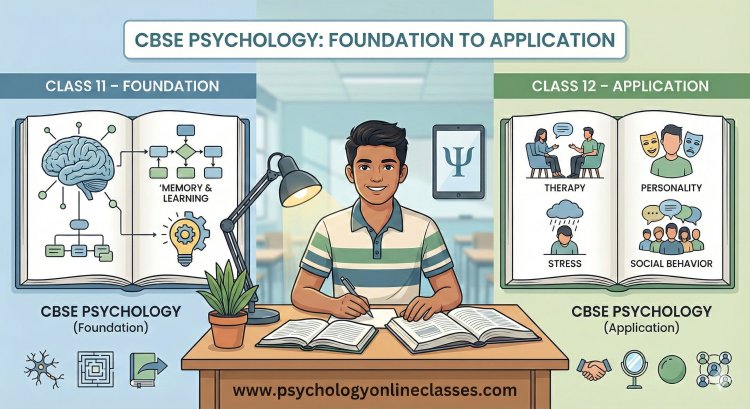
Class 11 Psychology = Foundation
Class 12 Psychology = Application + Real-world Understanding
Think of it like building a house:
- Class 11 is the base/foundation.
- Class 12 is the structure built on top of that foundation.
If your Class 11 basics are strong, Class 12 becomes MUCH easier.
Class 11 Psychology – What You Learn
1. Understanding Psychology (The Basics)
- Meaning, nature & scope of psychology
- Psychology as a science
- Branches & applications
➡ You learn what psychology actually is.
2. Methods of Enquiry (How Research Works)
- Experiments
- Surveys
- Observations
- Case studies
- Ethics
➡ This helps you understand how psychologists collect information.
3. Human Development (How People Grow)
- Childhood
- Adolescence
- Adulthood
- Factors affecting development
➡ Very scoring and relatable for Indian students.
4. Sensation, Attention & Perception
- How your senses work
- Illusions
- Factors affecting perception
➡ A fun chapter with diagrams and visual examples.
5. Learning
- Classical conditioning
- Operant conditioning
- Observational learning
➡ IMPORTANT for future psychology studies.
6. Memory
- Types of memory
- Forgetting
- Memory improvement
➡ Students enjoy this because they can apply it to their actual exam preparation.
7. Thinking
- Reasoning
- Decision-making
- Problem-solving
➡ Helps improve your own everyday thinking.
8. Motivation & Emotion
- Needs & drives
- Maslow’s theory
- Managing emotions
➡ A very relatable chapter for every teenager.
Overall: Class 11 = Easy to moderate + very scoring
If you understand basic concepts, you can score 90+ easily.
Class 12 Psychology – What You Learn
Class 12 syllabus is more advanced and practical.
Students learn how psychology is used in real-life situations.
1. Variations in Psychological Attributes
- Intelligence
- Aptitude
- Creativity
- Emotional intelligence
➡ Involves assessments & psychometric concepts.
2. Self & Personality
- Trait theories
- Psychodynamic theory
- Humanistic theory
- Behavioural approaches
➡ Slightly theoretical but very scoring.
3. Meeting Life Challenges
- Stress
- Coping
- Resilience
- Life skills
➡ Extremely relevant for Indian students.
4. Psychological Disorders
- Anxiety
- Depression
- OCD
- Schizophrenia
- Developmental disorders
➡ One of the most important chapters for future psychology careers.
5. Therapeutic Approaches
- CBT
- Behaviour therapy
- Humanistic therapy
- Psychodynamic therapy
➡ You understand how therapy is done.
6. Attitude and Social Cognition
- Attitude formation
- Change of attitude
- Prejudice & discrimination
➡ Helps students understand human behaviour in society.
7. Social Influence & Group Processes
- Conformity
- Obedience
- Group behaviour
➡ Very interesting and real-life oriented.
Overall: Class 12 = Moderate + application-based + highly relevant
Skill Development – What Class 11 Builds vs. What Class 12 Builds
|
Skill |
Class 11 Focus |
Class 12 Focus |
|
Understanding |
Basic concepts |
Advanced concepts |
|
Application |
Minimal |
High |
|
Answer writing |
Simple |
Detailed + structured |
|
Examples |
Daily life |
Real-world + clinical |
|
Memory load |
Less |
More |
|
Diagrams |
Many |
Fewer |
|
Scoring |
Very high |
High with good writing |
|
Difficulty |
Easy–Moderate |
Moderate–Advanced |
Is Class 12 Harder Than Class 11?
Yes—but in a good way.
Class 12 is more practical, meaningful, and deeper.
Students enjoy it more because they understand how psychology works in real life.
But:
✔ If your Class 11 basics are good → Class 12 becomes easy
❌ If your Class 11 basics are weak → Class 12 feels heavy
This is why I always tell my students:
“Class 11 is not a scoring class. It is a foundation-building class.”
And:
“A strong Class 11 student becomes a confident Class 12 student.”
To Explore our 11th & 12th Courses - CLICK HERE
Which Class Is More Scoring?
⭐ Both can be scoring — if you study smartly.
To score 90+ in both:
- Use diagrams
- Use examples
- Learn keywords
- Avoid long memorizing
- Write structured answers
Psychology is theory-based, but not memorization-based.
Practical Tips to Study Class 11 & 12 Psychology Smartly
✔ 1. Don’t read like a story — read in Q&A format
Write answers the way CBSE wants.
✔ 2. Use diagrams and tables
CBSE LOVES visual answers.
✔ 3. Link topics to your daily life
This makes concepts easy and unforgettable.
✔ 4. Do PYQs and sample papers
70% of questions repeat in similar patterns.
✔ 5. Revise regularly
Psychology needs consistency, not cramming.
❓ FAQs — Class 11 vs Class 12 Psychology
1. Which class is more difficult?
Class 12 is slightly more advanced, but not difficult if Class 11 basics are clear.
2. Do Class 12 students need Class 11 knowledge?
YES!
Many Class 12 concepts directly build on Class 11.
3. Can I score 90+ in both?
Absolutely, with proper guidance and writing practice.
4. Which class has more writing?
Class 12 requires detailed, structured answers.
5. Do I need tuition/coaching for both classes?
Not mandatory, but students who get guided learning often score higher and feel more confident.
My Message
Dear student,
Whether you choose Psychology in Class 11 or you’re already in Class 12, please know this:
You chose a beautiful subject.
Both classes are scoring, interesting, and meaningful.
Your basics today will become your strength tomorrow.
Study with understanding, not fear.
Study with curiosity, not pressure.
Study with confidence, not comparison.
You have the ability to excel —
and I’m here to help you at every step of your psychology journey.
What's Your Reaction?