Introduction to Psychological Experiments: Simple Examples for CBSE Students (Class 11 & 12 Guide)
A complete CBSE-friendly guide to psychological experiments for Class 11 and 12 students. Learn definitions, variables, steps, simple examples, and practical exam tips.
If you’re a Class 11 or Class 12 CBSE psychology student, you already know that psychological experiments are an important part of your syllabus — especially in Class 11.
But many students feel confused:
- “What exactly is a psychological experiment?”
- “How is it different from observation or case study?”
- “Why do we do experiments in psychology when it’s not a science lab subject?”
- “How do I write experiments for practical exams?”
Don’t worry — this blog will make everything simple, clear, and exam-friendly.
By the end, you will understand:
✔ What are psychological experiments
✔ Why they are important
✔ Simple examples you can relate to
✔ Steps in conducting an experiment
✔ Tips for writing experiments in CBSE practical exams
✔ FAQs for revision
Let’s begin!
What Is a Psychological Experiment? (Simple Definition for Students)
A psychological experiment is a scientific method used to study how people think, feel, or behave under controlled conditions.
In simpler words:
We change one factor → observe how it affects behaviour.
Example:
If we change the difficulty level of a task, does the speed of performance change?
You have:
- Independent Variable (IV) → what you change
- Dependent Variable (DV) → what you measure
- Control Variables → things you keep constant
Psychology may feel like a “theory subject,” but experiments make it scientific and measurable.
Why Are Psychological Experiments Important?
Experiments help psychologists:
✔ Test theories
✔ Identify patterns in human behaviour
✔ Understand cause–effect relationships
✔ Study learning, memory, attention, perception
✔ Predict behaviour scientifically
✔ Support real-life applications (education, therapy, workplace, etc.)
For CBSE students, experiments help you move beyond mugging theory — you experience psychology in action.
Basic Features of Psychological Experiments (CBSE Focus)
CBSE expects you to understand these key features:
- Objective – Why are we doing the experiment?
- Variables – IV, DV, control
- Hypothesis – A prediction
- Procedure – Steps to conduct the experiment
- Results – Observations or scores
- Conclusion – What did we learn?
Now let’s understand with simple examples.
Simple Psychological Experiment Examples for CBSE Students
These examples are very relatable, and similar ones appear in exams and practical files.
Let’s go through each experiment in a very simple way.
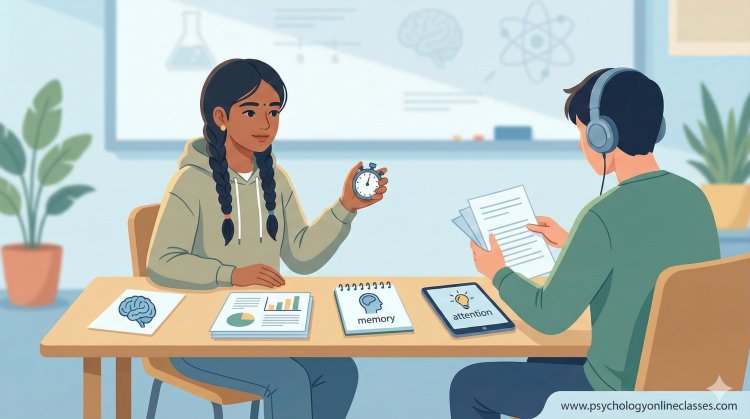
1. Experiment on Attention (CBSE Favourite)
Topic: Effect of Distraction on Attention
Independent Variable (IV): Presence of noise vs silence
Dependent Variable (DV): Number of correct responses in a letter cancellation task
Example:
Give a friend a cancellation sheet (like cutting certain letters).
- First, let them do it in silence
- Then with noise (music, people talking, etc.)
Expected Result:
Most students perform better in silence.
Why?
Because distractions reduce selective attention.
2. Experiment on Memory (Very Scoring)
Topic: Role of Meaningfulness in Memory
IV: Type of list – meaningful vs non-meaningful
DV: Number of words recalled
Example:
- List A: Mango, apple, banana, grapes (meaningful category)
- List B: Pin, cloud, shoe, wall (random items)
Ask your friend to memorize each list for 30 seconds.
Expected Result:
Students remember meaningful lists better.
Why?
Because meaningful information is encoded deeper.
3. Experiment on Learning (Ebbinghaus–style)
Topic: Effect of Repetition on Learning Speed
IV: Number of repetitions
DV: Time taken to memorize
Make someone learn a small poem or word list twice vs five times.
Expected Result:
More repetition → faster learning and better recall.
4. Experiment on Perception (Figure–Ground or Illusions)
IV: Type of figure
DV: Time taken to identify image
Show students optical illusions like:
- Rubin’s vase
- The duck–rabbit figure
- Müller-Lyer illusion
Ask them what they see first and how long it takes.
Expected Result:
Perception varies based on attention, past experience, and figure–ground organisation.
5. Experiment on Reaction Time (Fun and Engaging!)
IV: Type of stimulus – visual vs auditory
DV: Reaction time measured in seconds
Use any “Reaction Time Test” available online or simple stopwatch method.
Expected Result:
Auditory reactions are faster than visual ones.
(Fun fact: Because sound processing is quicker!)
6. Experiment on Stress & Performance (Yerkes–Dodson Law)
IV: Stress level – low vs moderate
DV: Performance on a simple task (like simple math)
Example:
- First attempt: No time pressure
- Second attempt: Time limit + competition
Expected Result:
Performance improves under mild stress.
How to Write Psychological Experiments in Your Practical File
Use this CBSE-friendly format:
- Aim
- Introduction
- Variables (IV, DV, controls)
- Hypothesis
- Material Required
- Procedure
- Observations / Table
- Result
- Conclusion
- Precautions
This format ensures full marks in practical exams.
Tips to Score Full Marks in Psychology Practical Exams
✔ Write neatly
✔ Use bullet points
✔ Label IV & DV clearly
✔ Keep tables clean
✔ Write a short conclusion
✔ Avoid overwriting
✔ Practice explaining the experiment aloud – viva questions come from your own file
To Explore our 11th & 12th Courses - CLICK HERE
❓ FAQs for CBSE Psychology Experiments
1. Are psychological experiments difficult?
No, they are simple and logical. Most involve basic tasks like memory, attention, or reaction time.
2. Do I need special equipment?
No. Simple materials like paper, timer, lists, and everyday tasks are enough.
3. How many experiments do I need to prepare for Class 11?
CBSE usually requires practical file + viva + 3–5 experiments.
4. Will experiments come in the board exam (Class 12)?
Class 12 has more case-based and project work, but understanding experiments helps in MCQs and short answers.
5. How do I prepare for practical viva?
Just understand:
- aim
- variables
- procedure
- conclusion
No need to memorize fancy definitions.
My Message
Dear student,
Psychological experiments are not about memorizing — they are about experiencing psychology.
Once you understand why people behave the way they do, this subject becomes one of the most exciting parts of your learning journey.
Stay curious.
Observe everything.
And remember — the mind is the most powerful laboratory you will ever explore.
You are doing great. Keep going!
What's Your Reaction?